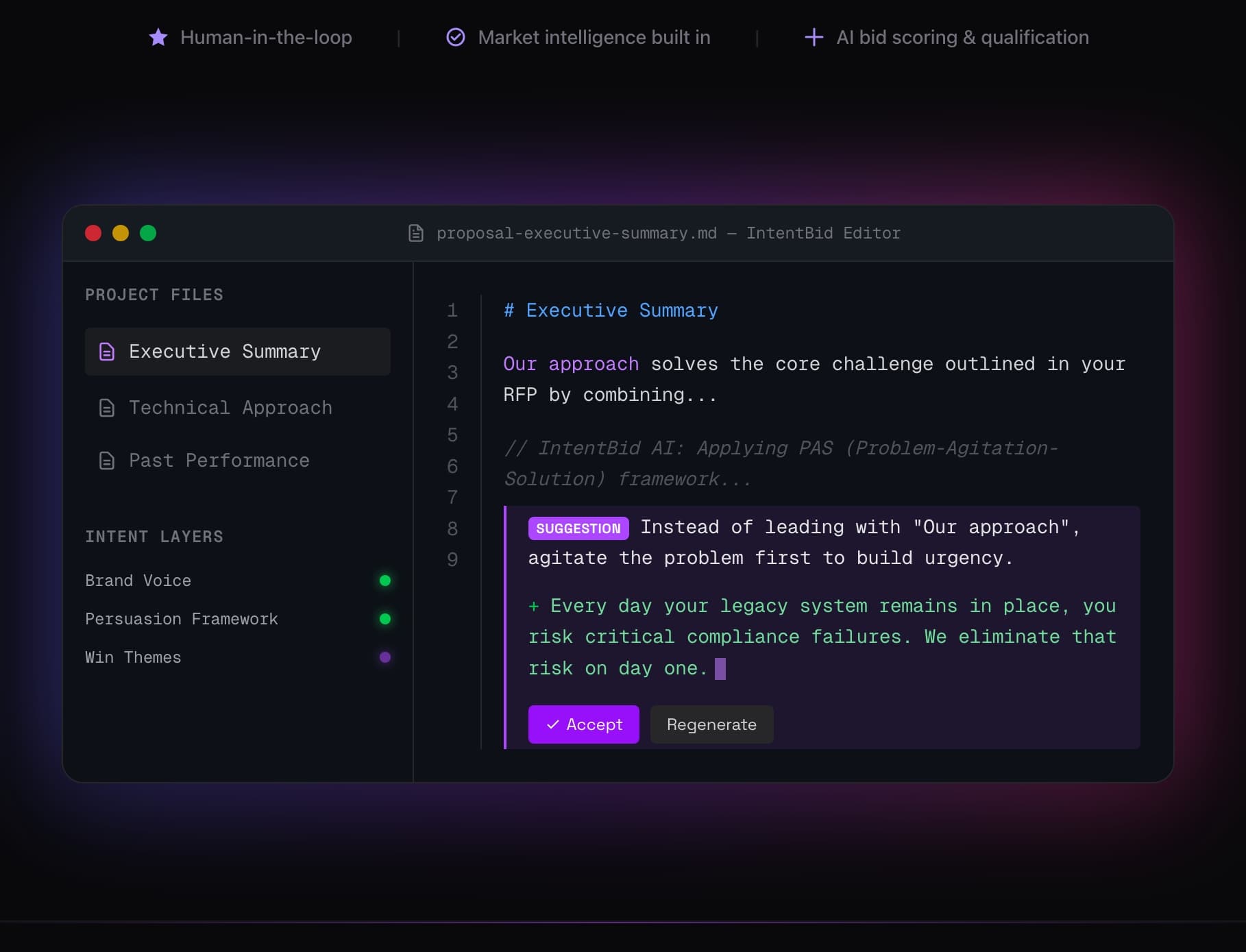
One RFP, one flat $50 price. You get a real Word working draft mapped to the solicitation and a completion plan that names every remaining blocker, owner, and next action. Every high-risk claim runs through an Evidence Gate, and a human approves before anything is treated as final — never on autopilot.
A working draft is a starting point, not a submission-ready or guaranteed-win document. Expert Completion is separately quoted.
Most AI proposal tools cite a source and call it grounded. IntentBid detects every high-risk claim — certifications, clearances, set-aside status, contract vehicles, key personnel — and reconciles each one against your verified truth. Unsupported claims are blockers at the readiness gate. Prove it, evidence it, or knowingly accept the risk. The honor system doesn’t pass.
Matched to a verified record in the Company Truth profile.
Backed by an attached source document in the evidence bundle.
No verified truth and no source. Cannot export until resolved.
The same gate runs on grant attachments: a requirement only counts as met when it has a linked evidence document. No linked proof, no submission-ready status.
IntentBid is in early production with qualified teams and active hardening underway. We ship against live deal pressure and real review friction, not a hypothetical demo script.
The wedge is not generic AI writing. It is proposal engineering: better pursuit decisions, better proof discipline, and better review signals before the team submits anything.
Most teams start writing too early. IntentBid makes pursuit, readiness, evidence, and review explicit before your team commits the week.
Proposal writing is only half the battle. IntentBid Intelligence gives capture teams the market context, benchmarks, and public-record workflows that make pursuit decisions sharper and proposal strategy more defensible.
Search live solicitations across agencies, jurisdictions, and verticals. Filter by NAICS, set-aside, due date, and value, then move the right opportunity into the workflow with one click.
Every opportunity is scored across fit, readiness, proof density, timeline feasibility, and strategic value. Get a visible recommendation before the team commits capture hours.
See how agencies buy, what contract vehicles matter, and where your profile fits the buying office. Use real procurement context instead of guesswork.
See incumbents, award cadence, average award size, and comparable historical patterns so your team enters the bid with clearer expectations.
See who wins in your market, where incumbents dominate, and how award value and set-aside patterns shift across the landscape.
Understand labor-category distributions, rate ranges, and pricing context before you finalize cost assumptions or narrative claims.
Powered by USAspending.gov, GSA CALC+, and public procurement sources. Intelligence flows into scoring, readiness, and proposal engineering — not just a dashboard.
The first win is not wasting proposal capacity on the wrong deal. IntentBid scores fit, capacity, agency context, and strategic value so capture teams can pursue, watch, or skip with visible rationale.
The strongest proposal teams find the missing pieces early. IntentBid surfaces proof gaps, missing personnel artifacts, benchmark risks, and compliance issues before your draft starts multiplying them.
IntentBid does not start from zero. Company Profile, past performance, certifications, named personnel, and prior outcomes become reusable building blocks that strengthen the next bid.
IntentBid is never autopilot. Humans make the pursuit decision, resolve blockers at the readiness gate, and approve every section before export. The AI accelerates capture work; it does not own the submission.
This is the moat: not one-shot generation, but layered proposal engineering that pushes every section toward evaluator trust.
Section L and M requirements mapped into the structure before drafting begins.
Capabilities, resumes, certifications, and past performance pulled from approved source material.
The differentiators that matter most to this evaluator repeated with discipline.
Section-specific argument patterns used where they strengthen the decision, not just the prose.
Positioning shaped by incumbents, alternatives, and what the buying office already expects.
Weak claims, thin proof, and risky language surfaced before export and submission.
The point is not more text. It is better pursuit decisions, tighter proof, and proposals that survive scrutiny.
Word, SharePoint, copy-paste
Tribal and deadline-driven
No explicit pursuit gate, weak reuse, and review happens too late.
Loopio, Responsive
Retrieval-first
Strong for finding old answers, weaker for bid qualification and evaluator-aware generation.
ChatGPT, Jasper, generic AI
General-purpose generation
Fast text, but no company truth, readiness gate, or proposal-specific controls.
Start with the $50 Simple Build: a real Word working draft and a completion plan for one RFP. Add Managed Readiness at $99/month only after your draft, if you want it kept reconciled and refreshed.
$50one-time
One RFP, one flat price, a real Word working draft you can finish.
$99/month
After your working draft, keep it reconciled and refreshed for a flat monthly fee.
Expert Completion (hands-on finishing) is separately quoted. Enterprise pricing lives in its own Enterprise track.